The 2026 Reality: Why Traditional Remote HR Is Failing
Recent industry research reveals stark challenges with conventional remote HR approaches:
- Sales reps forget 80% of training within 90 days when delivered via passive video modules
- Interview coordination consumes up to 35% of recruiter bandwidth, delaying time-to-hire
- Only 1 in 50 AI investments deliver transformational value. Most HR tech implementations fail to move beyond basic automation
- Remote workers report a 25% decline in psychological presence when using standard video platforms
The solution isn’t more tools, it’s better architecture. Metaverse platforms create persistent digital campuses where training, onboarding, and collaboration happen in a unified, immersive space.
Immersive Training: The "Flight Simulator" for Soft Skills
One of the most transformative applications of the metaverse in HR is AI-powered immersive training. Traditional video-based training has proven ineffective. Learners zone out, retention is minimal, and there’s no safe space to practice high-stakes conversations.
How It Works: AI Trainers in Virtual Environments
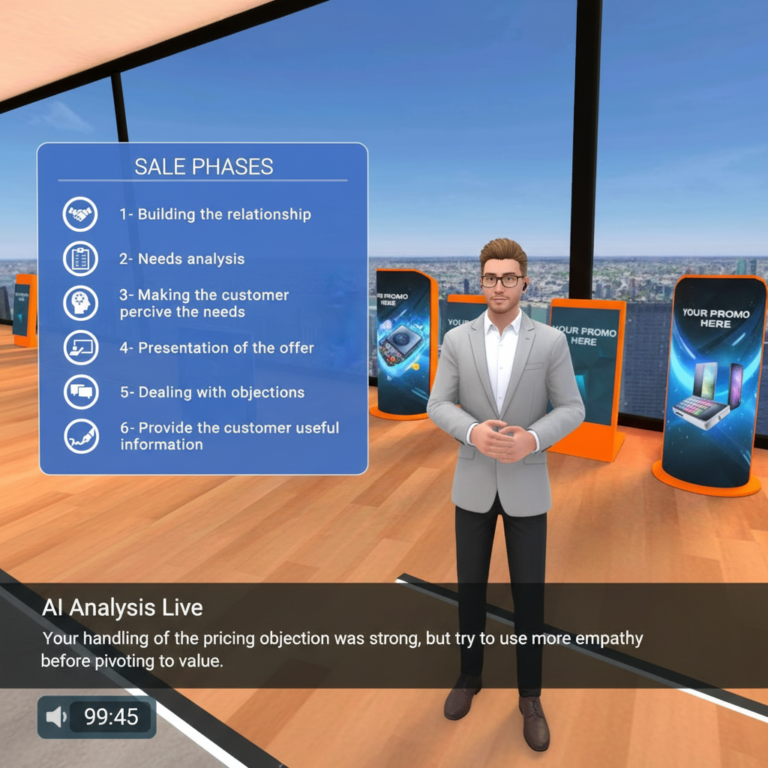
Leading organizations are deploying AI Trainers within their virtual campuses. These are intelligent avatars available 24/7 that allow employees to practice critical skills in private, safe-to-fail environments. These AI personas react in real-time to the learner’s tone, sentiment, and body language, creating training that “sticks” far better than passive modules.
Real-world applications include:
- Performance feedback simulations: Managers practice difficult conversations before the real thing
- Conflict resolution training: Employees navigate workplace disagreements with AI-generated scenarios
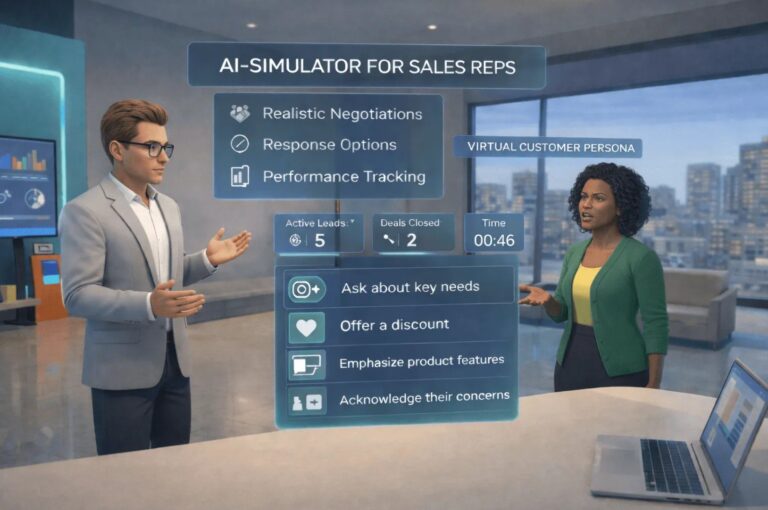
- Sales pitch refinement: Reps rehearse objection handling with adaptive AI prospects
- Onboarding role-plays: New hires practice customer interactions in realistic 3D scenarios
Studies show that VR-based training improves knowledge retention by 67% compared to 2D video, with engagement rates reaching 84%—dramatically higher than traditional e-learning.
Virtual Onboarding: The Self-Paced New Hire Journey
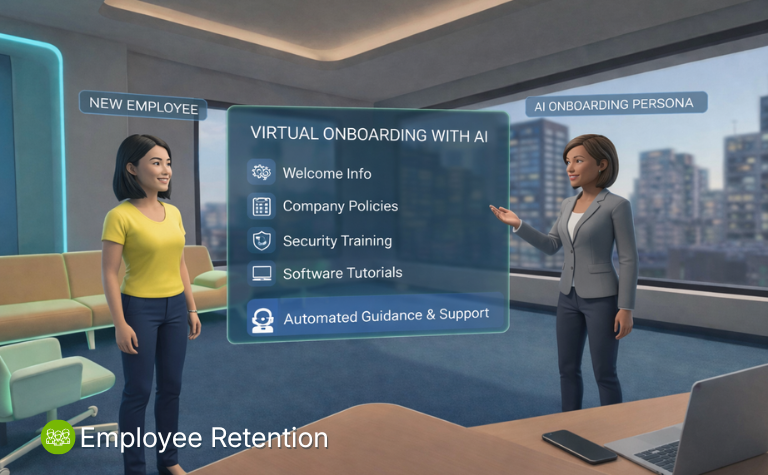
Traditional remote onboarding is a fragmented mess of PDFs, Zoom links, and email chains. In contrast, metaverse onboarding transforms Day 1 into an immersive, self-paced experience that starts the moment a contract is signed.
Key Components of a Metaverse Onboarding Campus
- The Culture Gallery: New hires explore a 3D showroom featuring company history, values, and global impact. They do all of this at their own pace, not rushed through a 90-minute presentation.
- The Team Lounge: Existing team members’ avatars “drop in” to greet newcomers, fostering social presence that text-based chat cannot replicate.
- Interactive Discovery Zones: Instead of reading a PDF handbook, employees interact with 3D objects and portals explaining benefits, IT setup, and organizational structure.
- AI Training Modules: Personalized simulations help new employees get up to speed quickly with trackable progress metrics.
By building this as an evergreen asset, HR teams save hundreds of hours in repetitive orientation sessions while delivering a superior employee experience that significantly boosts long-term retention.
Beyond the Coffee Break: Solving Remote Isolation
The greatest risk for remote workforces is the loss of spontaneous interaction. Standard communication tools are transactional. Colleagues only reach out when they need something. This erodes culture and innovation.
A 3D digital campus restores psychological presence. When employees see coworkers’ avatars moving through a shared virtual hall or sitting in a lounge, it triggers a sense of belonging that 2D video tiles cannot match.
How Virtual Campuses Foster Organic Connection
- Casual run-ins: HR designs “Social Zones” where employees from different departments naturally meet.
- Global inclusion: Whether in London, Tokyo, or New York, employees occupy the same shared space, removing the headquarters-vs-satellite office hierarchy.
- Always-on collaboration: Teams can “walk over” to a colleague’ for a quick question or chat.
From "Attendance" to "Actionable Insights"
Traditional HR tools tell you who logged in. But the metaverse tells you how they engaged. By shifting training and culture-building into a 3D environment, HR teams gain access to deep behavioral analytics that help optimize the employee experience.
Heatmaps of Interest: Identify which training modules or information booths are attracting the most attention and which are being ignored.
Engagement Metrics: Track time spent in collaborative zones versus solo work areas to understand team dynamics.
Iterative Design: Unlike a physical office lease, your digital campus is infinitely flexible. Use the data to reshape your immersive environment in real-time to meet the actual needs of your workforce.
This data empowers HR to move from reactive to strategic, using insights to continuously improve the digital employee experience.
See a live HR Campus in action and discover how to transition your L&D and Onboarding into a high-ROI evergreen asset.
HR Use Cases in Action
Leading global organizations have already implemented metaverse solutions for HR with measurable results.
Pfizer: Virtual Team Building

Pfizer engaged in a series of virtual team-building exercises, aiming to enhance internal relationships amidst their remote work setup. Guided by two expert coaches, comprehensive sessions of enjoyable team-building activities were crafted. These activities successfully fostered connection and trust among Pfizer’s participating employees, demonstrating the effectiveness of virtual environments in strengthening team dynamics.
BBVA: Immersive Onboarding
BBVA hosted their Open House event, attracting over 200 employees. This event was focused on onboarding and coaching their trainee team, providing comprehensive training on essential job functions. Participants benefited from a range of insightful conferences led by corporate leaders and engaged in team-building sessions, enhancing their collaborative skills.
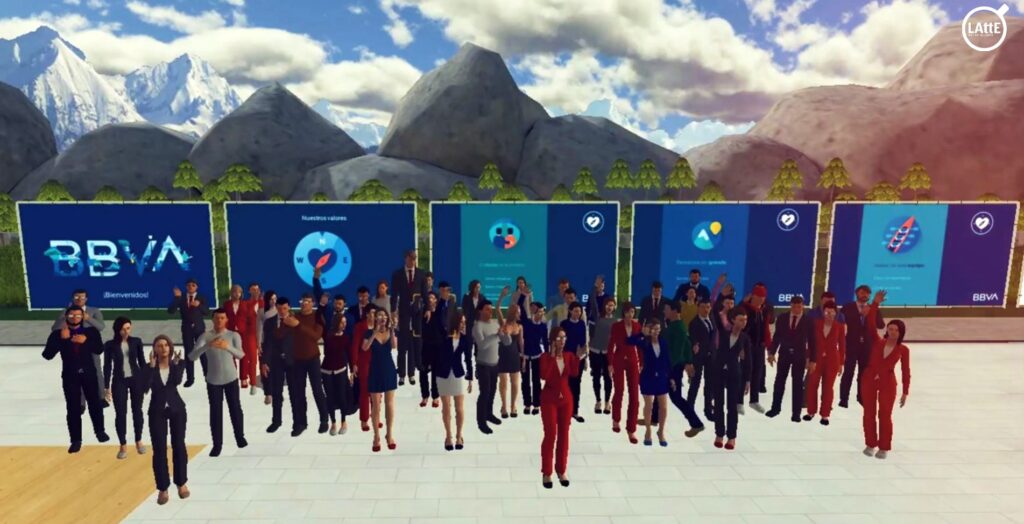
In close collaboration with the BBVA management team, a skillfully designed 3D branded environment not only aligned with BBVA’s vision but also effectively delivered the desired outcomes.
KPMG: Train the Trainers
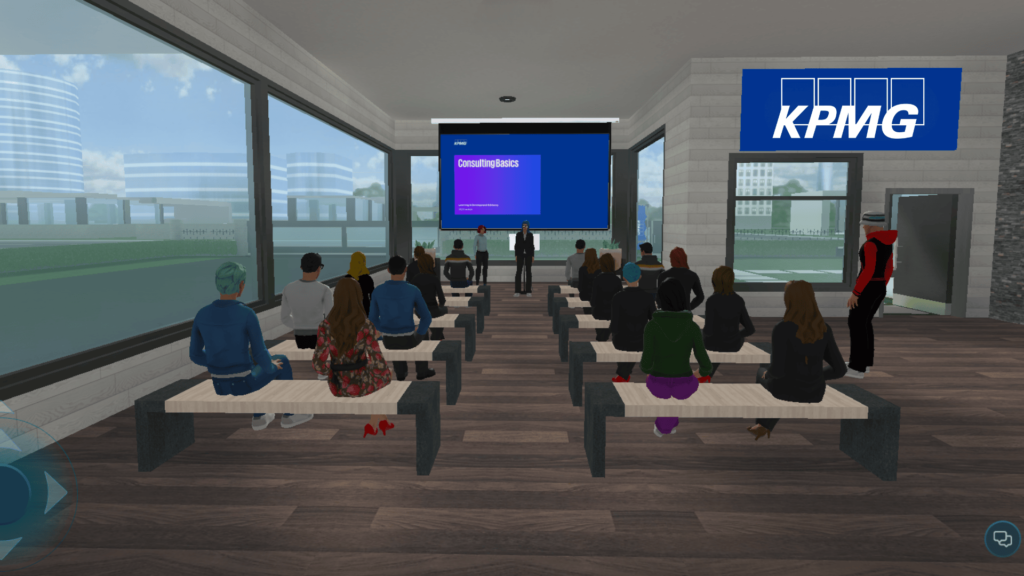
KPMG France revolutionized their “Train the Trainers” program by moving it from Microsoft Teams into the Virtway Metaverse. The avatar-based interactive experience significantly increased engagement and ensured participants’ full attention, creating a more effective learning journey.
MSX International
MSX International organized a series of forward-thinking sessions, bringing together their C-suite executives and company directors from across the globe. The primary aim of these sessions was to introduce new value methodologies and train these leaders on the optimal ways to integrate these methods into their strategic approaches. Furthermore, the objective was to empower these team leaders to disseminate the learned strategies to their respective teams effectively.
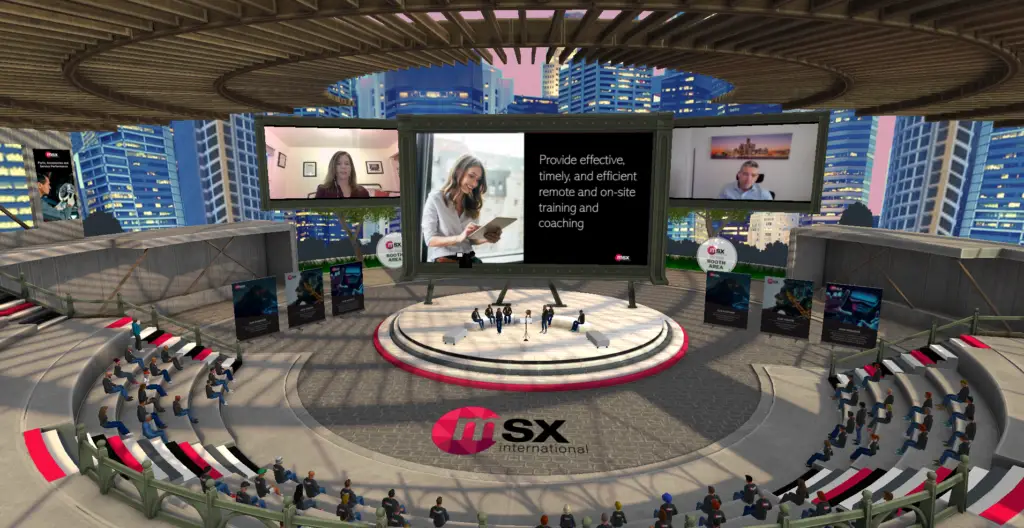
The sessions were comprehensive and dynamic, featuring keynotes from the CEO, live sessions to welcome new team leaders, and roundtable discussions enriched with interactive Q&A segments. To enhance the practical understanding, interactive workshops were conducted, along with the use of case studies. These case studies delved into historical approaches and the transition to contemporary implementation strategies. Additionally, the sessions included uniquely designed applied knowledge escape rooms, further engaging participants in a hands-on learning experience. This innovative approach facilitated by MSX International exemplifies the evolving landscape of corporate training and leadership development.
The 2026 Imperative: Audit Your Digital Employee Experience
Is your current remote infrastructure fostering growth, or is it driving turnover? As the workforce evolves toward 2026 standards, a persistent 3D campus is no longer a luxury… it is a competitive necessity for talent acquisition and retention.
Key questions to ask:
- Are new hires engaged and productive within their first 30 days, or are they drowning in documentation?
- Can employees practice high-stakes conversations safely before real-world scenarios?
- Do remote workers feel genuinely connected to the company culture and their colleagues?
- Can your HR team access meaningful behavioral analytics—not just login metrics?
- Is your L&D budget generating measurable ROI through lasting behavior change?
The Path Forward
The metaverse is transforming HR in tangible, measurable ways. From AI-powered immersive training and self-paced virtual onboarding to persistent digital campuses that restore human connection in remote work, the experiences speak for themselves.
As we navigate 2026, HR departments that embrace these technologies will not only improve efficiency, they’ll create workplaces where employees thrive, learn continuously, and feel genuinely connected to their organization’s mission.
Schedule a 15-minute strategy walkthrough with Virtway to see a live HR campus in action and discover how to transition your L&D and onboarding into a high-ROI evergreen asset.
FAQs about The Metaverse for HR Training and Development
What is the Metaverse and how can it be used in HR?
The metaverse is a persistent, shared 3D virtual environment where people interact via avatars. In HR, it enables immersive training, virtual onboarding, global collaboration, AI-powered skill development, and employee engagement in ways that traditional video platforms cannot match.
How does the metaverse improve training effectiveness?
Metaverse training delivers higher engagement (84% vs. 20% for traditional e-learning) and better retention (67% improvement over 2D video). AI trainers provide safe practice environments for high-stakes conversations, creating muscle memory that passive video modules cannot achieve.
What are the benefits of virtual onboarding?
- Cost and Time Savings: Virtual onboarding eliminates travel expenses and streamlines the onboarding process.
- Improved Connection: New hires can be introduced to colleagues and the workplace virtually, fostering a sense of connection.
- Interactive Training: Virtual onboarding can include interactive modules and simulations for faster learning.
How can the Metaverse enhance collaboration and communication in HR?
- Virtual Meeting Spaces: Teams can connect and work together regardless of location through virtual meeting spaces in the Metaverse.
- Customization: These virtual spaces can be customized to suit specific needs, such as whiteboards for brainstorming or conference rooms for presentations.
- Inclusivity: Remote workers can feel more connected to colleagues and company culture through interaction in the Metaverse.
How can the Metaverse be used for recruitment and hiring?
- Virtual Job Fairs: Companies can reach a wider pool of candidates by holding virtual job fairs in the Metaverse.
- Immersive Interviews: Metaverse-based interviews can provide a more interactive experience for both interviewer and candidate.
How can the Metaverse improve employee engagement and retention?
- Virtual Team Building: Team-building activities and events in the Metaverse can help employees connect and bond in a fun way.
- Sense of Community: The Metaverse can foster a sense of community and improve morale among remote workers.
- Career Development: Virtual training programs in the Metaverse can offer opportunities for career growth and development, leading to higher retention rates.
Are there real-world examples of companies using the Metaverse for HR?
- Pfizer: Used the Metaverse for virtual team-building exercises to strengthen relationships among remote employees.
- BBVA: Hosted a virtual open house event for onboarding and training new employees.
- KPMG France: Conducted a “Train the Trainers” program in the Metaverse to enhance the learning experience.
- MSX International: Organized virtual sessions for C-suite executives and company directors on new value methodologies.