AI-driven immersive training for airlines: building operational readiness without operational risk
Airlines operate in a world where “good enough” training can turn into real-world service failures, safety incidents, and costly operational disruption. Customer expectations are rising, regulations are tight, and irregular operations (IROPS) force teams to make fast decisions under pressure.
For Learning & Development (L&D) leaders, the challenge is clear:
- Training must be realistic enough to build confidence and readiness.
- Practice must be repeatable and measurable across multiple hubs.
- Learning has to happen without putting live operations, passengers, or brand reputation at risk.
That’s where AI-driven immersive training for airlines comes in, bringing employees into interactive, scenario-based simulations that mirror real airline environments and conversations.
Virtway helps enterprises create immersive training experiences designed around real workflows, so teams can practice what matters most before it matters most. Explore Virtway’s approach to immersive training experiences and how AI Agents for corporate training enable realistic role-play at scale.
Why airline training needs a new model
Traditional airline training methods still have value, but they often break down in the moments that define performance:
- Slide-based learning can’t simulate pressure. Learners may “know” the procedure but struggle when there’s time pressure, ambiguity, or emotional intensity.
- Live practice is expensive and hard to schedule. High-fidelity practice environments (aircraft, airport facilities, specialized equipment) are limited and costly.
- Service and communication skills are hard to train consistently. Tone, empathy, de-escalation, and decision-making are hard to standardize with classroom role-play alone.
Immersive simulation training is increasingly recognized as a practical way to provide procedural familiarization and scenario practice. For example, the Flight Safety Foundation discusses VR’s growing role as a practical training tool beyond experimentation in aviation contexts. (See Training With Virtual Reality.)
What “AI-driven immersive training” means in an airline context
In simple terms: it’s a digital environment where learners act, not just watch.
An airline-ready immersive training program typically combines:
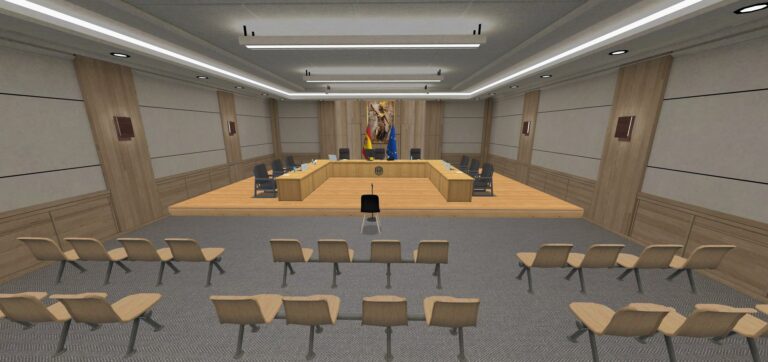
- A realistic 3D environment (e.g., airport areas, service desks, aircraft cabin layouts, crew rooms)
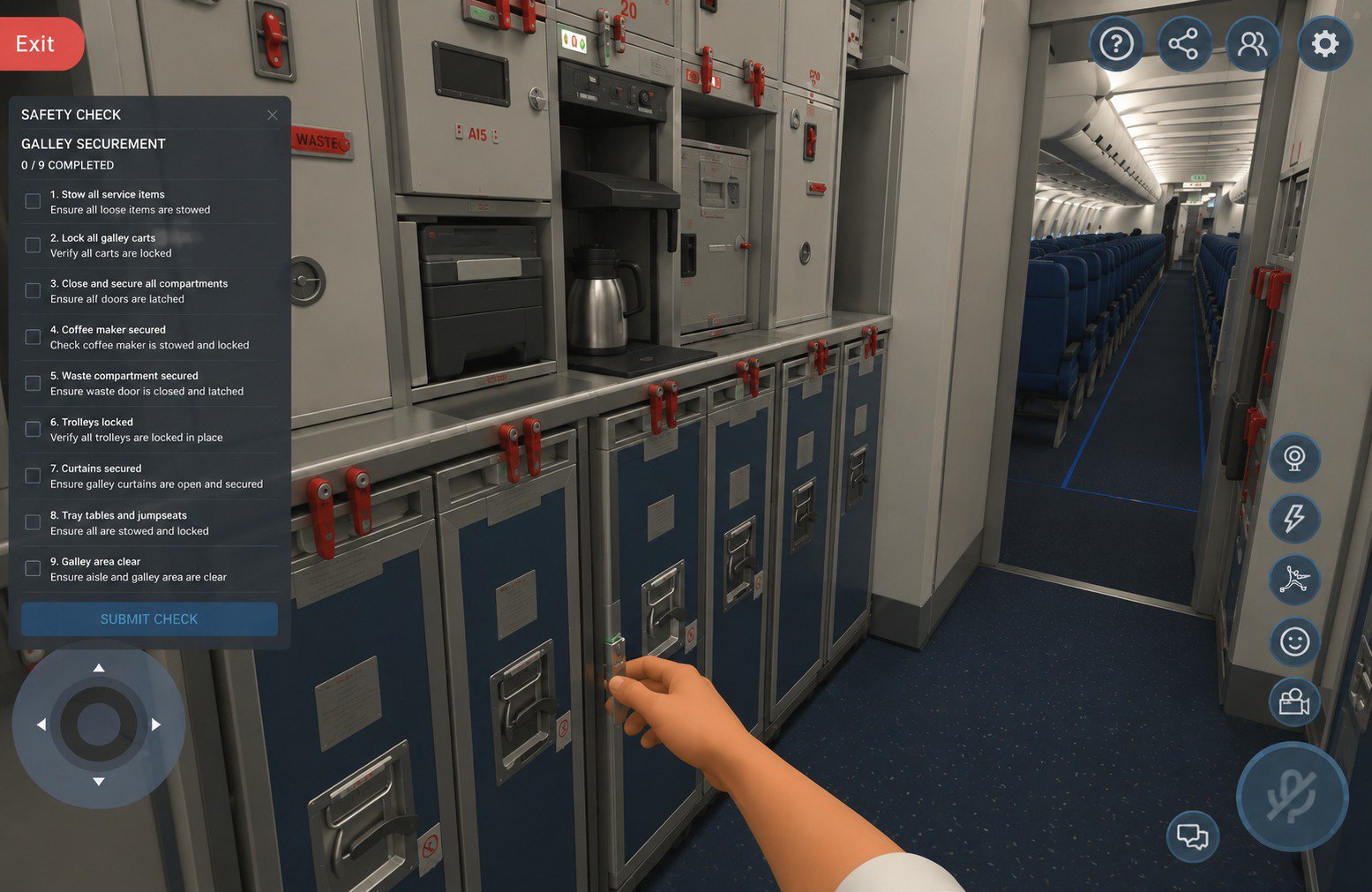
- Interactive objects and steps (procedures, checklists, decision points)
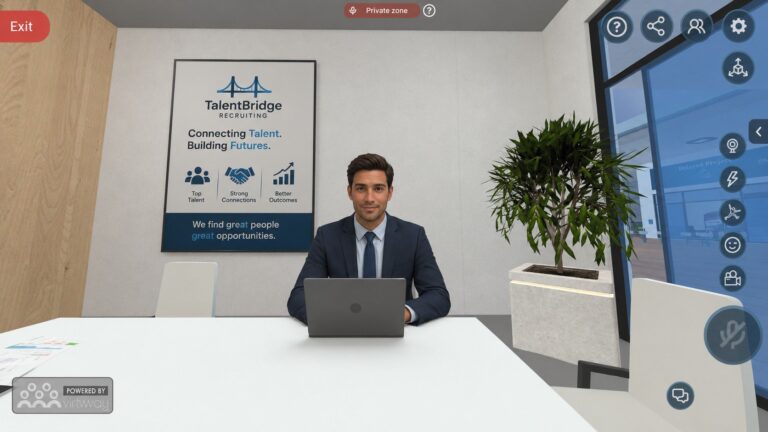
- AI-driven role-play (conversations with virtual passengers, customers, supervisors, or colleagues)
- Feedback and measurement (so L&D can see progress and target coaching)
Virtway’s platform is designed to support interactive experiences with voice and avatar-based participation. If you want a view into the underlying delivery options (browser-based vs. native app), see Virtway metaverse technology.
High-impact airline use cases (beyond pilot training)
When people hear “aviation simulation,” they often think of flight simulators. But many of the most scalable and business-critical opportunities for immersive training sit across customer-facing and operational teams.
Customer service and contact center simulations
Airline contact centers handle emotionally charged situations: cancellations, missed connections, baggage issues, and loyalty disputes. These scenarios are high-stakes because they impact customer trust.
Immersive, AI-driven role-play can help teams practice:
- De-escalation and empathy
- Policy explanation without escalation
- Rebooking conversations under time pressure
- Handling special assistance needs
If you want a comparable lens on how immersive AI training supports communication skills, Virtway’s article on immersive AI training for soft skills is a useful reference point.
Cabin crew service and safety practice in realistic environments
Cabin crew performance depends on procedural readiness and calm execution—often in constrained spaces.
Immersive simulations can support:
- Service routines and communication standards
- Safety procedures walkthroughs
- Emergency scenario decision-making (without live risk)
- Coordinated teamwork under stress
Academic research continues to explore how XR can improve cabin crew training and operational readiness (for example, see this study on immersive technologies in cabin crew training).
Ground operations training inside virtual airport environments
Ground ops is a precision game: turnaround coordination, ramp safety, irregular ops recovery, and cross-team communication.
Immersive training can help reinforce:
- Role clarity across teams
- Correct sequencing of tasks
- Decision-making during constraints and disruptions
- Communication protocols and handoffs
Rapid cross-training for peak periods and disruption
When demand spikes or disruptions hit, airlines often need fast mobilization and cross-training.
AI-driven immersive training can enable:
- Repeatable “day-one readiness” scenarios
- Branching practice paths for different roles
- Standardized learning for multiple stations and hubs
Team-based collaboration exercises
Operational performance is rarely individual. Many failures happen at the seams: miscommunication, unclear ownership, or handoff breakdown.
Immersive environments can bring distributed teams together to practice:
- Coordinated decision-making
- Shared situational awareness
- Incident response roles and escalation paths
Virtway’s approach to building engagement in interactive environments is also reflected in its metaverse events experience, which is designed around participation (not passive attendance)—a useful model when designing collaborative L&D sessions.
Why immersive training improves readiness
There are several reasons:
- Contextual memory: Learners practice in an environment that resembles where they’ll perform, which helps recall under pressure.
- Active learning: Doing and deciding creates stronger learning than watching.
- Safe repetition: Employees can repeat scenarios until performance becomes consistent.
- Emotional realism: AI role-play introduces the human element-tone, conflict, uncertainty-that traditional e-learning misses.
For L&D leaders, the key is to define success as observable behavior change and operational performance indicators—not just course completion.
What to measure: a practical evaluation scorecard for airline L&D
If you want the program to be taken seriously by operations leaders, define metrics that map to real performance.
Here’s a practical scorecard you can adapt:
| What to measure | Example KPI | Why it matters |
|---|---|---|
| Readiness in high-stakes scenarios | Pass/fail rate on scenario checkpoints; number of retries to proficiency | Shows confidence and consistency before live exposure |
| Quality of communication | Tone/clarity rubric; escalation rate; policy accuracy | Reduces conflict, repeat contacts, and brand damage |
| Decision-making under constraints | Time to decision; correct prioritization; compliance with SOP steps | Improves operational resilience in disruptions |
| Team coordination | Handoff accuracy; communication completeness; role adherence | Prevents “seam failures” between functions |
How to roll this out without overwhelming your team
Airline L&D teams are busy, and change fatigue is real. A successful rollout is less about launching a perfect “metaverse university” and more about creating a repeatable playbook.
Step 1: Start with one scenario that hurts today
Pick a scenario with high frequency and high impact, such as:
- IROPS customer conversations
- Cabin service breakdown and recovery
- Disruption coordination between ground ops and customer service
Step 2: Mirror the real environment (enough to matter)
The simulation doesn’t need photorealism to be effective. It needs recognizable context: the layout, the workflow, the decision points, and the language employees use.
Step 3: Build a feedback loop, then iterate
Use early sessions to capture:
- Where learners hesitate
- Which steps cause errors
- Where supervisors disagree on “what good looks like”
That data becomes your roadmap for improving SOP clarity and coaching.
If you want examples of how Virtway supports different types of immersive experiences across teams, browse immersive case studies.
Common objections (and how to address them)
“Will people actually use it?”
Adoption improves when the experience is easy to access. Virtway supports browser-based experiences as well as a native app option depending on the use case. See Virtway metaverse technology for an overview.
“Isn’t this just VR headsets?”
No. Immersive training can be delivered in different formats (including browser-based), and the value comes from interactive simulation + role-play, not the device.
“How do we prove ROI without bold claims?”
Focus on operationally meaningful indicators: reduced escalation, improved first-contact resolution behaviors, higher scenario pass consistency, and stronger handoffs.
In other words: measure performance in realistic practice, then connect it to the operational metrics your airline already tracks.
Next step: see an airline-ready demo
If you’re exploring modern approaches to airline L&D, the fastest way to evaluate fit is to experience a scenario firsthand.
- Request a demo through Contact Virtway
- Or explore the platform experience options on the Virtway homepage
When your teams can practice the real moments—customer tension, operational disruption, safety-critical routines—in a safe simulation environment, readiness stops being a guess. It becomes something you can train, observe, and improve.